Comparar a estabilidade de um talude em rocha alterada nos bairros altos do Cabuçu com um corte em solo saprolítico na região do Picanço revela contrastes que um projeto padrão ignora. Enquanto o primeiro exige atenção à orientação das descontinuidades do maciço cristalino, o segundo depende criticamente do regime de chuvas que satura o perfil superficial. Em Guarulhos, a expansão urbana avança sobre encostas com histórico de movimentação, especialmente em áreas próximas à Serra da Cantareira, onde a geologia local combina granitos e gnaisses do Complexo Embu com coberturas coluvionares instáveis. Nossa análise de estabilidade de taludes incorpora parâmetros de resistência obtidos em campanhas de campo e ensaios de laboratório, permitindo identificar mecanismos de ruptura antes que a obra entre em fase crítica. Para caracterizar a estratigrafia desses perfis, muitas vezes recorremos ao ensaio CPT em solos brandos e ao mapeamento de fraturas em rocha sã.
Um talude estável no seco pode romper em minutos sob chuva intensa — a poropressão redefine a geometria da segurança.
Escopo do trabalho em Guarulhos
Condições geotécnicas locais em Guarulhos
In Guarulhos, the rainfall pattern features annual averages exceeding 1400 mm, with rainfall concentrated between December and February, leading to wetting-drying cycles that progressively deteriorate the strength parameters of the surface soil. Unlike the drier regions of interior São Paulo state, the positive pore pressure from intense rain events here lowers the safety factor of slopes that remained stable during the dry season. Excavations for road projects, such as those serving the São Paulo/Guarulhos International Airport, require slope stability analyses that account for full infiltration scenarios, employing transient flow modeling and progressive failure assessment. Disregarding this seasonality means taking a risk that construction insurers already price strictly in the metropolitan area.
Nossos serviços
Slope stability analysis goes beyond a single safety factor. Every project in Guarulhos demands a tailored combination of field investigation, laboratory testing, and computational modeling. Below are the works that make up our technical approach:
Modelagem computacional de estabilidade
We apply rigorous limit-equilibrium methods (Morgenstern-Price, Spencer) using both commercial and academic software, calibrated with strength parameters from triaxial and direct shear tests. The analyses cover static, pseudo-static, and transient flow scenarios for heavy rainfall, producing graphical output of critical failure surfaces and safety factor maps.
Dimensionamento de contenções e drenagem
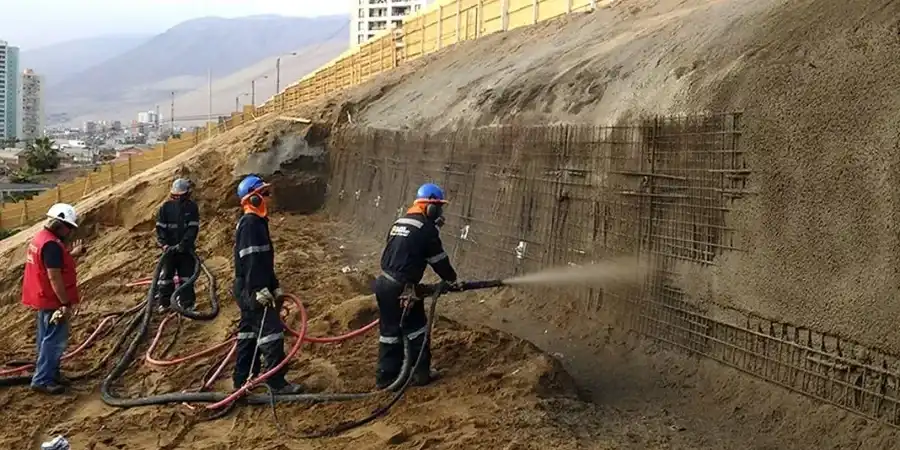
Based on the stability analysis, we design retaining systems suited to the local geometry and soil: gravity walls, anchored curtains, or soil nailing. Surface and subsurface drainage systems are an integral part of the design, including sub-horizontal drains, crest channels, and energy dissipation structures.
Dúvidas comuns
Qual é o custo médio de uma análise de estabilidade de taludes em Guarulhos?
The cost for a complete slope stability analysis in Guarulhos starts at around R$ 100,000, varying with slope height, geological complexity, number of analysis sections, and need for additional laboratory tests. This price covers field geotechnical investigation, material characterization, computational modeling, and issuance of the Technical Responsibility Note (ART).
Quais parâmetros de resistência são utilizados na análise de um talude em solo saprolítico?
In Guarulhos' saprolitic soil, shear strength parameters vary considerably with weathering degree. We use effective cohesion between 5 and 25 kPa and friction angle between 26° and 34°, obtained from direct shear or CIU triaxial tests on undisturbed samples. The failure envelope is nonlinear at low confining stresses, and our modeling accounts for this curvilinear behavior when it affects the safety factor.
A análise considera o efeito das chuvas intensas de verão na região?
Yes. We incorporate full infiltration scenarios using transient flow modeling, based on historical rainfall series from the INMET weather station in Guarulhos. The analysis computes pore pressure variation over time, identifying the critical moment when the safety factor reaches its lowest value. This method is especially important for residual soil slopes, where apparent cohesion decreases sharply upon saturation.